Toledo People Search!
- ✔ Contact Info
- ✔ Phone Numbers
- ✔ Criminal Records
- ✔ Income Info
- ✔ Neighbors
- ✔ People's Age
- ✔ Property Ownership
- ✔ And Much More
Search People In Toledo, OH
Searching for people in Toledo, OH? Enter a name and press the search button and our USA people search will quickly locate and tell you where in Toledo that person lives. The result includes address, telephone number, criminal records, income, property records, and more.
The report includes:
- Address
- Phone Number
- Criminal Records
- Public Records
- Vehicle Records
- Income
- Occupation
- Education
- Property Ownership
- Age
- Gender
- Speeding Tickets
- Arrests
- Assaults
- Court Records
- Conviction Details
- Sex Offenses
- Jail Records
- Police Report
- Driving Violations
- Mugshot(s)
- Bankruptcy Filings
- Email Addresses
- Social Accounts
- Census Records
- Articles From Newspapers
- Immigration Documents
- Photos
- Birth
- Marrige
- Divorce
- Death
- Military Records
.......and much more.

Toledo, Ohio
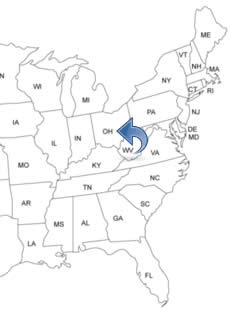
Toledo is located in the northwestern part in the U.S. State of Ohio, and is the fourth largest city in the state. The city is famous as the "Glass City". For a century it dominated the glass manufacturing industry in the United States.
The city is recognized as the "Home of the Jeep". The Historic Old West End neighborhood is a beautiful neighborhood of Victorian, Edwardian, Tudor, Georgian, and other architectural styles.
To See And To Do In Toledo
- Visit the Vistula Historic District
- The Toledo Botanical Garden
- National Museum of the Great Lakes
- Toledo's Science Center
- Glass Pavilion
- HH Antiques, Collectibles & Gifts
- The Frogtown Froggy Museum
- Imagination Station
- Valentine Theater
- Patron Saints Brewery
- Maumee Bay Brew Pub
- Franklin Park Mall
- Boyd's Retro Candy
- The Toledo Museum of Art
- The Glass City River Wall
- The Toledo Zoo & Aquarium
- Ye Olde Durty Bird
- Downtown Toledo
History Of Toledo - Timeline
Thousands of years before the first Europeans came to the area, the Erie, Kickapoo, and Shawnee people lived in the area. In 1615, the French-Canadian scout, Etienne Brule, explored the area. The area deterred settlers due to the Great Black Swamp, a vast, difficult-to-traverse wetland. In 1744, a French geographer furnished a map for the area.
In 1762, missionaries came to the area but struggled with Indians, and they suffered massacre or were driven away. In 1788, authentic records shows a settlement but it was not permanent. In 1794, Fort Miamis was built by the British, and General Wayne built Fort Defiance. It was a crucial military outpost during the Northwest Indian War to secure the Northwest Territory.
In 1800, a fort called Fort Industry was completed. In 1807, Peter Navarre and his brother Robert, and their father, came and built cabins in the area, and they established a trading post. Peter Navarre became famous as an American scout and guide in the wars with the Indians and British. In 1810, there were now about 67 white families settled in the area that had built homes and farms with utensils, and cattle.
In 1817, Port Lawrence was an early settlement. Port Lawrence was platted by Cincinnati investors. Benjamin F. Stickney built a warehouse. Joseph Prentice and his second wife Eleanor, arrived and settled. In 1822, in a small frame house, Frederic Prentice was born. He is believed to be the first white child born in todays Toledo. Frederic Prentice later became a large landowner.
In 1823, John Baldwin and his family, settled in the warehouse that Benjamin F. Stickney had built. John Baldwin and Cyrus Fisher opened one of the first stores in todays Toledo, called John Baldwin and Co. In 1833, a post office was established, and Benjamin F. Stickney platted the village Vistula. Port Lawrence and Vistula merged to form the new community of Toledo, and it was founded and incorporated as part of the Michigan Territory.
In 1834, James Irvine Brown published the first number of the newspaper the Toledo Herald, and Miss Harriet Wright, a niece of Governor Silas Wright, of New York, taught school in one of the buildings in the town. In 1835, the Toledo Blade newspaper was published, and the Toledo War started. It was a boundary dispute between the state of Ohio and the adjoining territory of Michigan. Governor Mason of Michigan sent a force of 250 men to Toledo to hunt for and capture Benjamin F. Stickney, but he was not found.
In 1836, the railroad was completed, a hotel opened, and the Toledo Gazette newspaper started. In 1837, after the Toledo War, Toledo was re-founded in and incorporated in Ohio. A fire department was established. The last 100 of the Indians, who lived there, left. In 1844, a church was built. In 1845, the Miami and Erie Canal opened. It was a canal that ran from Cincinnati to Toledo.
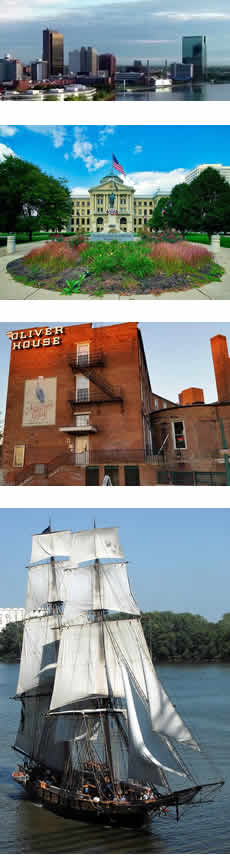
In 1846, around 2000 people lived in Toledo. In 1849, the Toledo Public Schools (TPS) was established. In 1862, horse-drawn streetcars began to operate in the city, and the Cherry Street bridge was built. In 1859, the Oliver House was built. In 1863, the St. Patrick's Church was built. In 1864, the Toledo Library Association was founded. In 1870, he Toledo Society of Natural Sciences was founded. In 1872, the Toledo University of Arts and Trades was founded. In 1873, the Toledo Public Library opened. In 1876, the Woodlawn Cemetery was established.
In 1888, Edward Drummond Libbey brought the glass industry to the city with the New England Glass Company (Libbey Incorporated). In 1890, the Pythian Castle was built. In 1895, the Valentine Theatre opened. Michael Owens patented a glass-blowing machine to make glass bottles, and the Edward D. Libbey House was built. In 1898, the Edward Ford Plate Glass Company built a plant in Toledo, and the First Church of Christ, Scientist was built. in 1896, the The Lucas County Courthouse was built.
In 1900, 131,822 people lived in the city, and the Zoological Gardens was established. In 1901, the Museum of Art was founded. In 1903, the Owens Bottle Machine Company was founded. In 1904, the first electric trolley service started. In 1907, Lee deForest started a radio station with Frank Buttler. In 1909, the jazz pianist Art Tatum was born in Toledo. In 1910, the Willys-Overland automobile plant was built. It was the primary production site for military Jeeps.
In 1918, the Municipal Hospital opened. In 1921, the WSPD (originally WTA), began radio broadcasting. In 1929, the Hillcrest Hotel was built. In 1930, the Toledo Hospital building opened. In 1931, the High Level Bridge was built. In 1932, the National City Bank Building was built. In 1934, the comedian Jamie Farr was born in the city. Best known for playing Corporal Maxwell Klinger in MASH, wearing women's outfits, trying to get discharged from the army.
In 1948, the WSPD TV began broadcasting. In 1953, WGTE-TV began broadcasting television. In 1958, the jazz and soul singer Anita Baker was born in the city. In 1959, the Toledo Opera company was founded. In 1964, the Botanical Garden was established. In 1971, the Franklin Park shopping mall opened. In 1978, the actress and filmmaker Kate Holmes was born in the city.
In 1982, the Fifth Third Center at One SeaGate building was built. In 1987, the Glass City Center opened. In 2002, the Fifth Third Field baseball stadium opened. In 2009, the Huntington Center arena opened. In 2025, 265,638 people lived in the city.